Also in Nepal: A New Social Media Platform That Doesn’t Track Your Data

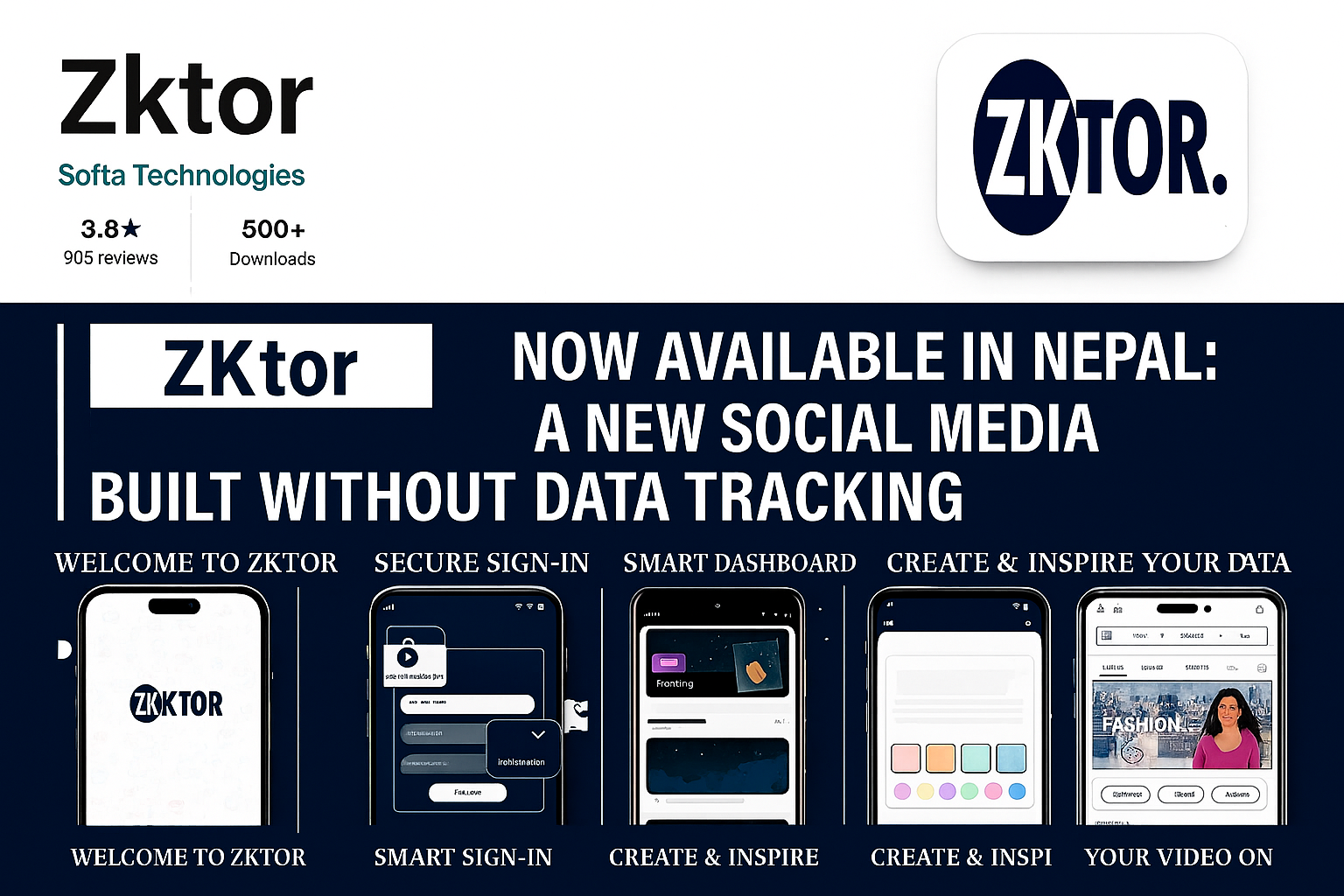
Most Nepalis today use social media without thinking twice. We scroll, post, message, run small businesses, promote tourism, sell homemade products, follow creators — all on platforms built far away from Nepal. These apps helped us connect, but they also quietly collect our data, track our behaviour, and often turn our attention and personal information into profit.
As artificial intelligence, deepfakes, fake profiles and online harassment grow, many Nepali users, especially young people and women, are starting to ask a simple question: Is there a safer way to be online? This is where a new name, ZKTOR, is beginning to attract attention in Nepal.
What Is ZKTOR, and Why Is It Different?
ZKTOR is a privacy‑focused social media app developed by Softa Technologies, an Indian tech company. Unlike mainstream platforms that rely on tracking user behaviour, ZKTOR is built with one core idea: users should not have to give up their privacy just to participate online.
The platform is currently in beta and has already crossed over half a million users across India, Nepal, Sri Lanka and Bangladesh, with especially strong interest from Gen Z users and women. The company is now expanding testing to other South Asian countries, positioning ZKTOR as a regional platform rather than just another app launch.
Why This Matters for Nepal
Nepal’s digital life is deeply influenced by local realities, including family reputation, community relationships, women’s visibility, language trust, youth migration, remittance‑based households and small informal businesses. For many people here, an online mistake doesn’t stay online. A misused photo, leaked content or fake video can quickly cause real‑world harm. ZKTOR is designed to reduce that risk.
The app uses privacy‑by‑design architecture, Zero Knowledge Server systems (meaning even the platform doesn’t “know” user content), No URL‑based media sharing, no behavioural tracking, default multi‑layer encryption. In simpler terms, it avoids the common model where users click “I accept” without knowing how their data will be stored, reused or sold.
Safer Space, Wider Participation
For Nepal, this could change who feels comfortable participating online. A safer and more predictable platform makes it easier for young women to express themselves; students and creators to share work without fear; home‑based sellers to do business; small tourism operators and service providers to gain visibility; local entrepreneurs to build trust online. Instead of pushing people to go viral at any cost, the platform focuses on dignity, control and reliability.
More Than Just Social Media
ZKTOR is part of a wider ecosystem Softa is building for South Asia: Subkuz – for hyperlocal news and diaspora communities; Ezowm – for local and neighbourhood‑level commerce; Hola AI – for safety and intelligence support; and ZHAN – a transparent, hyperlocal advertising network.
For Nepal, this matters because local markets including tutors, clinics, guides, creators, women‑led enterprises, neighbourhood shops already exist. The challenge is organising them digitally without intrusive ads or constant surveillance.
“We have avoided foreign venture capital pressure and operates Softa with a low‑cost, capital‑disciplined model , which is similar to how ISRO built space technology affordably,” said ZKTOR’s founder, Sunil Kumar Singh. “The goal is to create long‑term digital infrastructure, not just chase short‑term attention.” Singh grew up in rural India and spent over two decades working in Finland’s disciplined, privacy‑conscious design culture. That experience shapes the platform’s philosophy.
ZKTOR still has important tests ahead, including user retention, governance, monetisation, safety controls and scale. It is not a finished success story yet. But for Nepal, the conversation it introduces is timely: Should we remain only users of global platforms, or can South Asia including Nepal, help shape a digital future built on trust, privacy and local opportunity? If platforms like ZKTOR succeed, Nepal may not just adopt the next phase of social media — it may actively participate in defining it.
क्याटेगोरी : English


तपाईको प्रतिक्रिया दिनुहोस