Special Investigation: Nepal Secures NPR 7 Billion Global Fund Grant Amidst Escalating UNDP Accountability Crisis
 Praveen Kumar Yadav
शनिवार, २०८२ चैत्र ७ गते १७:१२ मा प्रकाशित
Praveen Kumar Yadav
शनिवार, २०८२ चैत्र ७ गते १७:१२ मा प्रकाशित
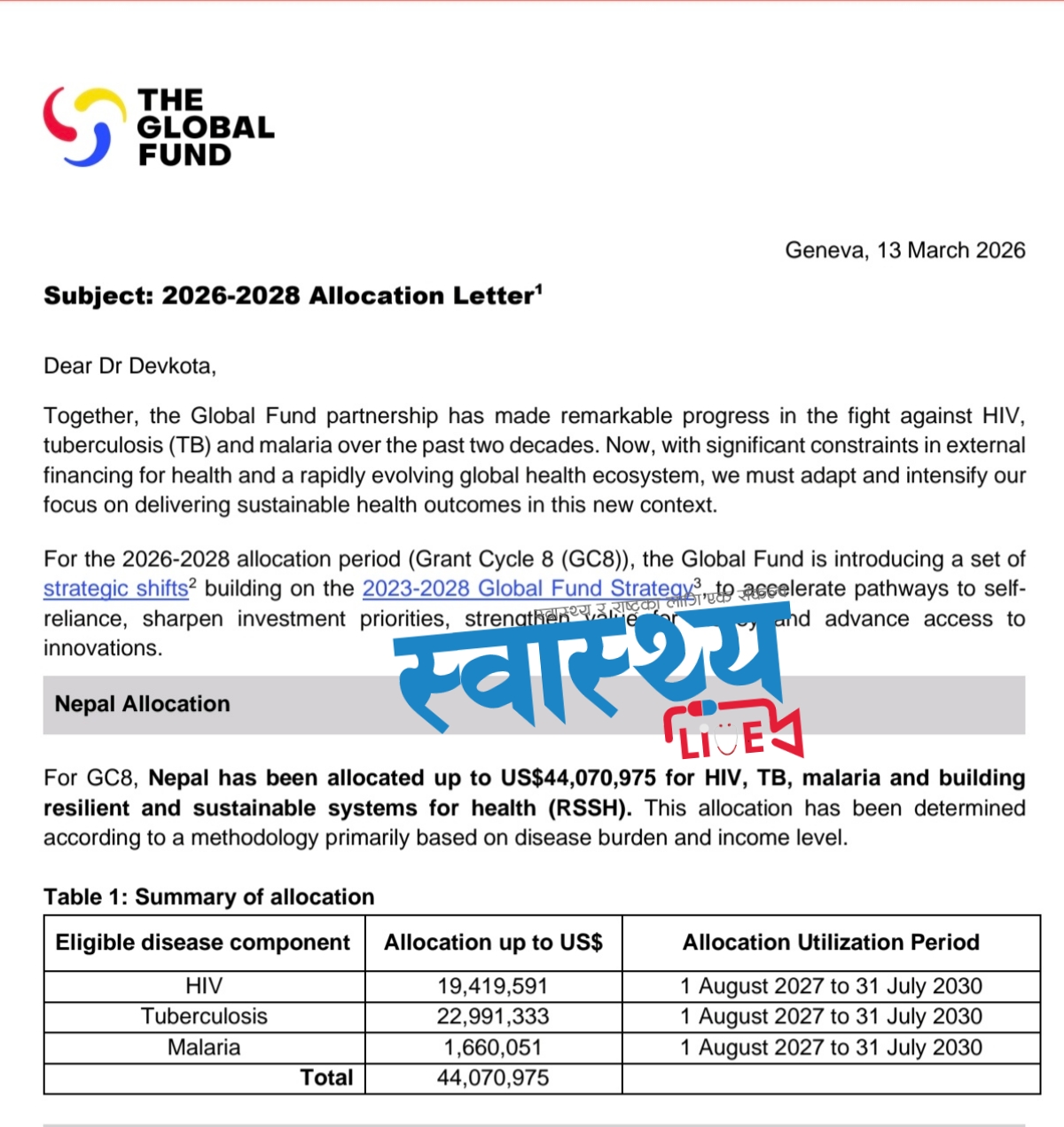
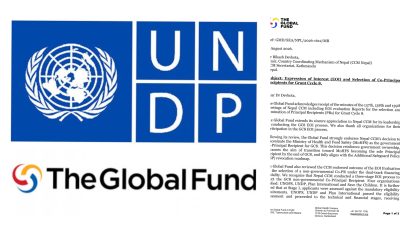
KATHMANDU — Nepal has officially secured a critical USD 44.07 million lifeline, equivalent to approximately NPR 7 billion, from the Global Fund to bolster its fight against HIV, tuberculosis, and malaria through 2028. While the funding represents a significant victory for the nation’s public health infrastructure, the announcement arrives at a volatile moment of institutional friction. Internal documents and mounting official frustration point to a systemic failure of oversight within the United Nations Development Programme (UNDP), the agency currently serving as the Principal Recipient of these substantial funds.
The grant, covering the 2026–2028 implementation period, comes as international health aid faces tightening global constraints following significant aid reauthorizations and cuts by the U.S. under President Donald Trump. For Nepal, the stakes have shifted from the purely financial to the deeply institutional, raising urgent questions about whether the state can reclaim its role as a sovereign implementer or if it will remain a passive observer to the alleged arbitrary spending of international agencies.
A Blueprint for Self-Reliance Amidst Financial Flux
According to documents obtained by Health Live, the NPR 7 billion allocation is strategically targeted to maintain the continuity of life-saving services across the country. The financial roadmap designates USD 22.99 million specifically for tuberculosis control, while USD 19.41 million is earmarked for HIV programs and USD 1.66 million for malaria elimination. Furthermore, over NPR 110 million has been set aside for broader health system strengthening, an area critics argue has been historically neglected in favor of administrative overhead.
In a move to address social inequities, the Global Fund has also carved out a USD 750,000 catalytic fund aimed at dismantling human rights and gender-related barriers. This strategic reserve is intended to reduce discrimination and ensure that rights-based service delivery reaches the “last mile” of underserved communities. Officials emphasize that these investments must focus on expanding disease detection and improving the quality of prevention programs rather than being absorbed by the bureaucracy of implementing partners.
The UNDP Accountability Gap and the Sovereignty Loophole
Despite these ambitious health goals, a deepening shadow hangs over the implementation structure. Since 2008, the UNDP has served as the Principal Recipient (PR) of Global Fund grants in Nepal, a role that critics argue has created a parallel system bypassing national laws and accountability. Because UN agencies are not bound by Nepal’s national procurement or labor laws, internal sources allege that the UNDP has managed billions of rupees with arbitrary authority, often prioritizing high-level foreign junkets and administrative expenses over tangible benefits for the Nepali populace.
The Ministry of Health and Population (MoHP) has long been accused of remaining a “passive observer” regarding the funds received by the state. “The ministry has historically lacked the resolve to question the UNDP’s spending patterns,” one senior official stated on the condition of anonymity. This lack of oversight has led to a system where the state has effectively become a spectator to its own health funding, leading to calls for a more transparent, competitive, and credible selection process for the Principal Recipient role as mandated by Global Fund guidelines.
Professional Integrity Under Fire
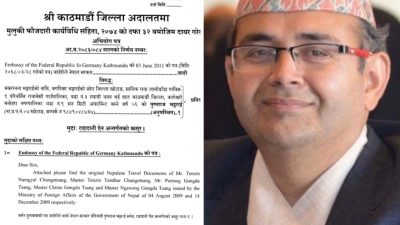
The most pointed criticism of the current implementation structure involves the appointment of Gajananda Prakash Bhandari as a Program and Monitoring & Evaluation (M&E) Specialist. Bhandari was previously at the center of a legal storm when he was prosecuted for the possession of a fake academic certificate, a discovery made during the Nepal Police’s high-profile “Operation Quack.” Although the Nepal Medical Council permanently revoked his license following the revelation of credential forgery, the UNDP has continued to assign him significant oversight responsibilities.
This retention has raised urgent questions regarding governance and transparency within the international agency. Public health experts argue that the goal of “strengthening” a national health system is fundamentally undermined when the oversight mechanism employs individuals who have been barred from professional practice by national regulators. The discrepancy between the high standards of integrity expected by the Global Fund and the actual hiring practices on the ground has become a focal point for those demanding a structural overhaul.
A Litmus Test for the “Balen Era”
The upcoming grant cycle will be overseen by the Country Coordination Mechanism (CCM), an entity traditionally led by the Secretary of the Ministry of Health and Population with participation from the Ministry of Finance and civil society. However, with an incoming government expected to be led by Balen Shah, officials suggest that a thorough investigation into the UNDP’s management of previous grants is no longer optional but a necessity. This transition represents a significant opportunity for Nepal to reclaim its sovereignty by moving away from international intermediaries and toward domestic resource mobilization.
The Global Fund has explicitly encouraged Nepal to further integrate HIV, TB, and malaria programs into the primary healthcare system to achieve long-term sustainability. For the new leadership, the mandate is clear: ensure that the Principal Recipient selection is conducted through an open and transparent process that holds implementers accountable to Nepali law. As the nation stands at this crossroads, the NPR 7 billion grant represents more than financial assistance; it is a test of international credibility and a significant opportunity to prove that life-saving funds can be spent in the wards of Nepal rather than the offices of an “untouchable” implementation arm.
क्याटेगोरी : English, अन्तर्राष्ट्रियट्याग : ##CCM Nepal, ##mohp nepal, ##UNDP NEPAL
तपाईको प्रतिक्रिया दिनुहोस