Dharan’s Independent Icon or Divider?
 Dr Sandesh Lamsal
शुक्रवार, २०८३ वैशाख १८ गते १२:५८ मा प्रकाशित
Dr Sandesh Lamsal
शुक्रवार, २०८३ वैशाख १८ गते १२:५८ मा प्रकाशित
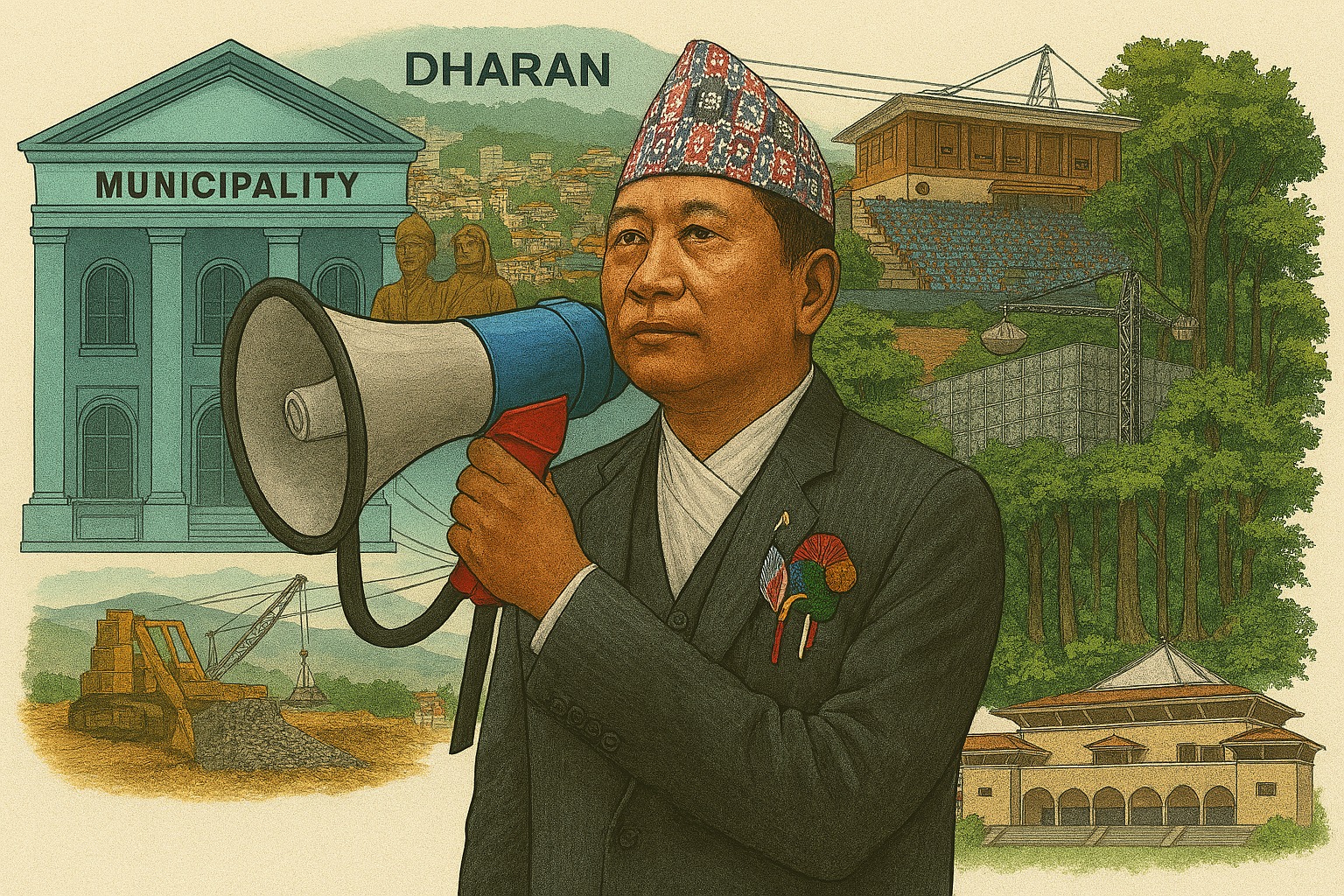
Harka Raj Rai, better known as Harka Sampang, was once widely celebrated as a populist disruptor in Dharan Sub‑Metropolitan City. Born in 1983 in Khartamchha, Khotang, he was elected mayor in 2022 as an independent candidate, campaigning on promises to fight corruption, promote compulsory labour, and swiftly address the city’s long‑running drinking water crisis. Seen by many as a tough, nonpartisan activist, Sampang came to embody public frustration with entrenched political parties.
Four years on, as founder and chairperson of the Shram Sanskriti Party and now a federal parliamentarian, questions have intensified over whether his confrontational style has delivered accountable governance or whether it has fuelled social divisions under the banner of ethnic pride and anti‑establishment politics.
Public records, audit findings and court proceedings point to a recurring pattern of procedural lapses, unclear use of public resources, and fundraising practices that critics say operate at the margins of established law. According to them, these practices, combined with provocative ethnic rhetoric by party figures, have sharpened rifts in an already strained city shaped by water scarcity, ethnic sensitivities and religious tensions. Supporters, by contrast, maintain that Sampang’s emphasis on shramdaan, or voluntary labour, reflects genuine people‑led development. The evidence, however, calls for closer scrutiny.
From activist to mayor
Sampang moved to Dharan in 1998 after completing his School Leaving Certificate. He earned a bachelor’s degree in English and political science from Mahendra Multiple Campus, worked as a tutor, and later sought employment abroad in Iraq and Afghanistan.
During the Maoist insurgency, he faced allegations of posing as a Maoist cadre in 2005 to extort donations in Dharan. Sampang has repeatedly denied any such role, describing himself instead as a victim who was assaulted by Young Communist League cadres after the 2006 peace agreement and later reconciled with them. While these allegations were never established in court, they resurfaced following his political rise.
He first gained prominence through protests against what he termed corruption in the Dharan drinking‑water project and the widening of the Madan Bhandari Highway. In 2020, he was arrested and fined after vandalising a water source while opposing an Asian Development Bank‑supported plan. His confrontational methods struck a chord with residents disillusioned by decades of unmet promises from established parties. In the 2022 local elections, he won the mayoralty, defeating candidates from major political forces.
Municipal projects and public funds
After assuming office, Sampang strongly promoted shramdaan for parks, water schemes and municipal infrastructure. Official audits and civic investigations, however, raise questions about transparency. Audit observations and independent reporting have flagged spending on projects such as Shram Sanskriti Park that occurred without formal discussion in executive meetings and without clear declaration within municipal processes. The mayor had publicly presented such parks as built entirely through voluntary labour.
Similar concerns have emerged around drinking‑water initiatives. Donations for the Kokaha stream project reportedly reached tens of millions of rupees. In public statements, Sampang himself cited figures exceeding Rs 70 million in collections, though independent reporting has confirmed lower amounts. Expenditure details later released by his group indicate the absence of a formal audit or procurement process, with funds spent on items such as food, allowances, materials and surveys. Executive members have stated that efforts to route funds through municipal accounts were overridden. Critics argue that the absence of competitive bidding and post‑completion audits runs counter to procurement norms. To date, no comprehensive donor reconciliation has been published.
In June 2025, a fresh controversy erupted when Sampang reportedly sought retrospective municipal payments for a gabion wall constructed through a labour campaign at Multilingual School in Ward 16. A consumer committee from another ward was formed after construction to process bills. Deputy Mayor Aindra Bikram Begha publicly described the move as illegal and a breach of financial protocol. Tensions escalated inside the municipal office, with reports of supporters attempting to intimidate officials. The episode reinforced accusations of personalised decision‑making.
Budgets, factories and authority
Sampang also initiated commercial ventures under the “Maya Dharane” label, including turmeric powder and soap production, presented as employment‑generating schemes. Municipal records confirm that city funds were allocated for the turmeric project and that executive approval was granted. Critics, however, argue that blending municipal funding with political branding and personal messaging blurred the line between public initiative and political enterprise, raising questions about role clarity, procurement practices and accountability.
Donation drives and disclosure
Throughout his tenure, Sampang repeatedly appealed for public contributions for projects ranging from Dharan’s water schemes to a suspension bridge in distant Darchula. Funds for the Sumnima–Paruhang statue, symbolising Kirat Rai identity, were raised through foundation‑linked accounts rather than municipal channels, with significant contributions reported from the Nepali diaspora. However, no audited statements reconciling inflows, expenditures and project progress have been made public.
Nepal’s Local Government Operation Act and Donation Act require prior approval, receipts and disclosure for fundraising by public office holders. The Sunsari chief district officer has confirmed that no formal permission was sought. While Sampang’s team later released partial financial details in response to criticism, these figures were neither independently verified nor consistent with earlier claims. Experts also note that foreign donations must comply with foreign exchange and anti‑money‑laundering regulations.
Religion and communal tension
Sampang’s handling of religious disputes has further unsettled social harmony. An older video in which he appears sympathetic to religious conversion resurfaced amid protests in 2023 against an alleged illegal church in Dharan. Instead of enforcing municipal regulations, the case was referred to court, a move that critics interpret as selective inaction. Sampang has not publicly disclosed his religious affiliation, and his party’s manifesto prioritises labour culture. Nonetheless, his approach has raised broader concerns about consistency in enforcing local laws. While Nepal’s constitution guarantees religious freedom, it also prohibits forced conversion, making neutrality by elected officials essential.
Party rhetoric and ethnic fractures
The Shram Sanskriti Party, launched after Sampang’s mayoral term, has drawn scrutiny over the rhetoric of some of its leaders. The party’s general secretary, Aryan Rai, has been publicly associated with statements targeting Chhetri and Brahmin communities, including repeatedly labelling them “foreigners”. Critics argue that such language, circulated widely online, aligns with a pattern of ethnic mobilisation that Sampang’s platform has failed to curb, particularly through symbolic initiatives such as the Sumnima–Paruhang statue on contested land.
After being rejected as a contender for prime minister during the Gen Z‑led protests, Sampang intensified attacks on major parties, alleged foreign interference, and state institutions, portraying them as elitist or hostile to Rai interests. While dissent is a vital part of democracy, observers argue that the conflation of ethnic appeals with unsubstantiated allegations has contributed to instability in Dharan and beyond.
Vote‑bank politics and emotional gameplay
Another strand of criticism now shaping public debate concerns land encroachment and squatter politics. During his tenure as mayor of Dharan, Sampang himself took an assertive stance against illegal encroachments and unauthorised settlements, arguing that the occupation of public land undermined urban planning, environmental safeguards and the rule of law. At the time, these actions were justified as necessary steps to restore civic discipline and institutional authority.
Following his election as a Member of Parliament, however, critics argue that his political posture on the same issue appears to have shifted. They point to what they describe as an emerging strategy of vote‑bank politics, in which emotive appeals are increasingly directed at the very groups that were earlier subject to eviction and enforcement. According to observers, this shift represents a turn toward emotional mobilisation, where the language of grievance and inclusion risks overshadowing consistent policy positions.
Concerns have also been raised about individuals linked to Sampang’s party being associated with efforts to legitimise encroachments on public land under the guise of squatter settlements. While such claims require careful verification, their persistence in public discourse reflects unease over whether enforcement principles are being selectively recalibrated to consolidate electoral support.
Land and squatter politics have long been powerful emotional tools in Nepal’s urban centres, where rapid migration, housing shortages and administrative inertia intersect. For critics, the contrast between Sampang’s earlier actions as mayor and his current messaging underscores questions of coherence and credibility in reformist politics. Supporters, meanwhile, frame the shift as a pragmatic response to social realities that rigid enforcement alone has failed to resolve.
Why scrutiny matters
Nepal’s local governance framework exists precisely to prevent opacity and unilateral decision‑making. Auditor General observations, court rulings against procedural violations, and the absence of audited donation accounts together suggest a pattern that merits institutional scrutiny by bodies such as the Commission for the Investigation of Abuse of Authority and the Election Commission.
Voters and civil society must assess whether the Shram Sanskriti Party’s emphasis on compulsory labour and self‑reliance translates into transparent, inclusive development or whether it entrenches personalised rule that risks deepening ethnic and religious divides. Full public disclosure of finances behind projects funded by donations and taxes is not punitive; it is a democratic obligation. Without it, the language of reform risks obscuring the very practices it once set out to challenge.
Scrutiny is not harassment. It is the rule of law in action. Only through accountability can Nepal distinguish between genuine reform and the consolidation of unchecked power under the guise of popular revolt.
क्याटेगोरी : English, विचार





तपाईको प्रतिक्रिया दिनुहोस